Quiz Answers – Design of Flexible Pavements
| 1. | Major defect types that can be observed on flexible pavements are: | |
| Cracking | ||
| Deformations | ||
| Disintegration and wear | ||
| ⊗ | All of the above | |
| 2. | The results of the AASHO road test are still used today. | |
| ⊗ | True | |
| False | ||
| 3. | The AASHTO design method had the drawback of being: | |
| Too easy | ||
| Long | ||
| ⊗ | Empirical | |
| None of the above | ||
| 4. | The cracks in the picture below is due to: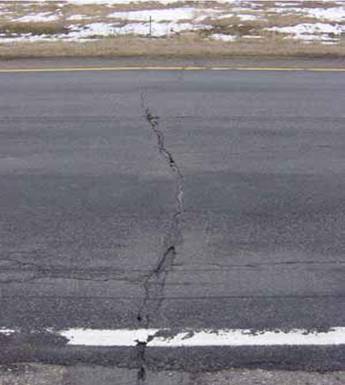 |
|
| High temperature | ||
| ⊗ | Low temperature | |
| Rain | ||
| None of the above | ||
| 5. | Raveling, bleeding and pothole formation can be rated as signs of: | |
| Disintegration | ||
| Wear | ||
| ⊗ | Both | |
| 6. | The Timber truck in the picture below is completely stuck on an earth road due to too ________ contact pressures and a too low shear resistance of the pavement material. |
|
| ⊗ | Low | |
| High | ||
| 7. | A system with a stiffer layer on top of a softer half space is called a ___________ layer system. | |
| One | ||
| ⊗ | Two | |
| Three | ||
| Four | ||
| 8. | If the horizontal tensile stress at the bottom of the top layer is too high, it will be the cause for cracking of the __________ layer. | |
| ⊗ | Top | |
| Bottom | ||
| 9. | ________________ shear stresses act in the longitudinal and transverse direction | |
| Vertical | ||
| ⊗ | Horizontal | |
| 10. | Knowledge on axle and wheel loads is important but even more so is knowledge on the contact pressures. | |
| ⊗ | True | |
| False | ||
| 11. | Temperature has a significant effect on the: | |
| stiffness | ||
| fatigue | ||
| permanent deformation resistance of asphalt mixtures | ||
| ⊗ | All of the above | |
| 12. | TGP takes a ___________ value when the top part of the total asphalt thickness is softer than the bottom part. | |
| Negative | ||
| ⊗ | Positive | |
| 13. | Moisture has a large effect on the ____________ and bearing capacity of soils and unbound materials | |
| Stength | ||
| ⊗ | Stiffness | |
| 14. | Repeated load tests are needed to obtain the stiffness characteristics of asphalt mixtures in relation to the loading time and _______. | |
| Length | ||
| ⊗ | Temperature | |
| 15. | The procedure proposed by the Belgian Road Research Centre is preferred since it is based on a dataset. | |
| More detailed | ||
| Smaller | ||
| ⊗ | Larger | |
| More accurate | ||
| 16. | ______________ of the asphalt mixture has to do with the fact that asphalt mixtures have the capacity to “repair” themselves. | |
| Peeling | ||
| Straining | ||
| ⊗ | Healing | |
| None of the above | ||
| 17. | Because of lateral wander, the ______________ stresses and strains don’t always occur in the same location. | |
| Minimum | ||
| ⊗ | Maximum | |
| 18. | Which one of the following does not affect the vertical stress at which shear failure occurs in a granular material? | |
| the amount of confinement | ||
| the cohesion | ||
| angle of internal friction of the material considered. | ||
| ⊗ | the strain | |
| 19. | The picture below displays excessive pavement deformation due to deformation of the: | |
| bound base | ||
| ⊗ | unbound base | |
| 20. | Van Niekerk’s work has also been used to develop relations for the allowable ____________ strain at the top of the unbound base or subbase. | |
| ⊗ | Vertical | |
| Horizontal | ||
| 21. | Depending on the load transfer across these cracks, significant traffic induced tensile strains might develop to these cracks resulting in longitudinal cracking. | |
| ⊗ | Parallel | |
| Perpendicular | ||
1. 4 – All of the Above
2. T
3. 3 – Empirical
4. 2 – Low Temperature
5. 3 – Both
6. 1 – Low
7. 2 – Two
8. Top
9. 2 – Horizontal
10. T
11. 4 – All
12. 2 – Positive
13. 2 – Stiffness
14. 2 – Temperature
15. 3 – Larger
16. 3 – Healing
17. Maximum
18. 4 – Strain
19. 2 – Unbound Base
20. Vertical
21. Parallel
100% correct answers: verified 06 Feb 2022
Note: Should you find the quiz has changed and these answers no longer apply, please send an email notifying us to [email protected] We will update this answer sheet.